The End of Freedom
The brief 300-year experiment in human freedom that began in the enlightenment is unfortunately ending. It’s worth remembering what came before, so we can predict what will come after. History doesn’t repeat, but it rhymes.
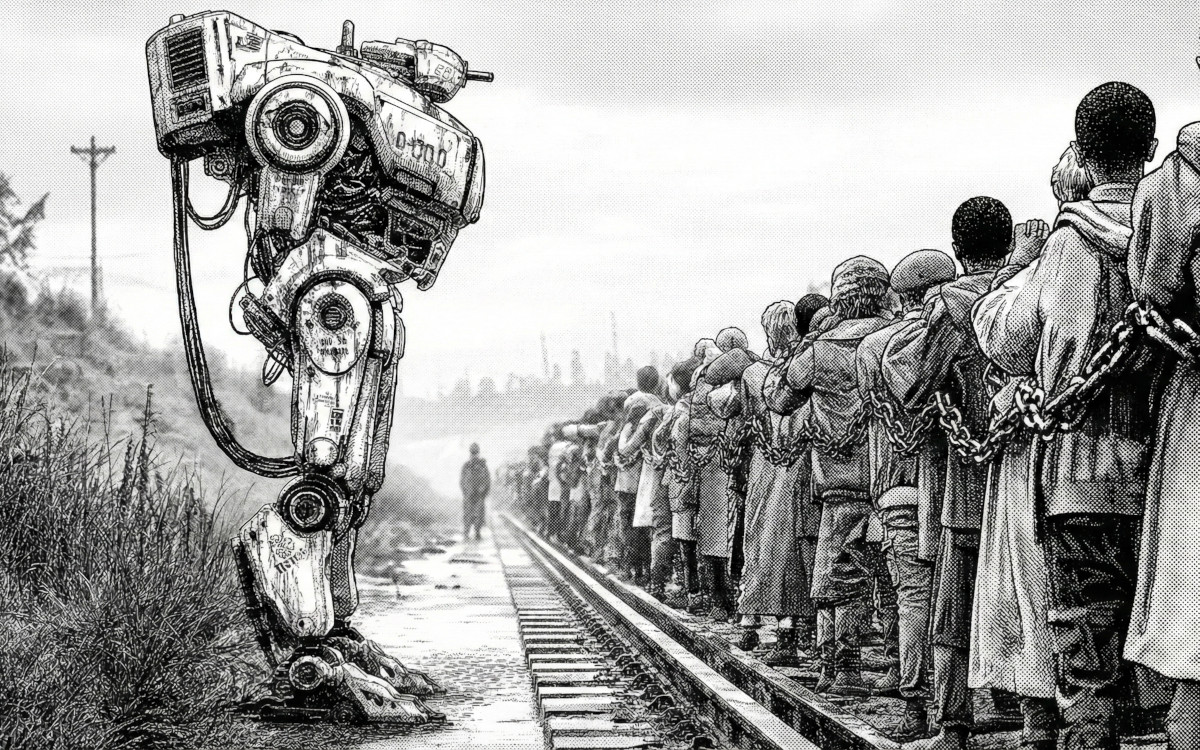
In the beginning there was homo sapiens, then hunter-gatherer tribes, then agriculture, slavery and feudalism. Land, and the natural resources in it (capital), was the basis of all wealth and power. Most people (serfs) belonged to the land. And the value of a serf was the work they could perform on the land. Then came the industrial revolution which required smart, educated workers. And the value of the land (or more broadly capital) decreased in comparison to the value of work. Now, we have intelligence too cheap to measure. And soon we will have robotic platforms that enable these intelligences to perceive and act on the real world, to do real work. And the shift of power will violently snap back to capital.
In a feudalistic society there was very little social mobility. Social mobility is a result of opportunities to perform valuable work and accumulate capital. If there is no valuable labor available, or if it’s not available for most humans, that means no accumulation of capital is possible.
Serfdom wasn’t quite slavery, but it wasn’t too far off. People couldn’t be sold or traded independently from the land. But they owed labor to the lord (capital owner). The alternative was death, or living outside of the confines of society, at the mercy of criminals or warring warlords. No lord meant no protection.
We are entering again a period of limited social mobility. Capital is becoming more important than labor. But there are limited opportunities to accumulate capital, and to rise up in the social ladder of capital accumulation. The most profitable jobs, which typically rely on intelligence, are also the most likely to be automated.
Throughout feudalism, legitimacy was important; nobody ruled alone! That is also changing. Technology makes human participation to maintain societal systems less necessary. Moreover, societies as a whole seem to have become much more passive. As long as basic needs are fulfilled, they seem uninterested in defending their rights or upholding standards of morality or governance.
In the United States, for example, recent revelations have made it completely clear that a broad spectrum of lawmakers at the highest levels have engaged in immoral, illegal and treasonous activities. To the disgust of anyone who bothers to inform themselves. Nevertheless, nothing was done about it. Nobody was arrested, nobody was punished.
Of course they would not prosecute themselves. But what’s really shocking, is the level of passiveness of the broader population as a whole. A few centuries ago, many would have revolted against relatively minor grievances. Today it seems no crime is bad enough to cause uproar. Bread and circus.
Western societies have become so domesticated that even the most despicable crimes don’t seem to trigger any social upheaval. There is not even a need for governments to pretend they have a moral justification to govern.
The comparison between 1984 and Brave New World has been so overdone that it has become a cliche. But that doesn’t make it any less valid. Modern Western civilization was not subjugated by an iron fist and a boot in the neck. But domesticated through toxic food, overmedication, porn addiction, 24/7 entertainment (dopamine hijacking), breakdown of nuclear family relationship dynamics, and dependency on the state for the most fundamental human tasks, maintaining health, educating children, associating with each other, accumulating capital and so on. We have become human cattle.
During feudalism there was a small number of holders of all knowledge. In Europe, that was the Church, which had a monopoly on knowledge and legitimacy. Most people could not read or write, and relied on priests to tell them how to live life, and to know what is true and what is not.
In the future, most people will learn through AI assistants. Few will do research from original sources, spending vastly more time and cost. And even fewer will question the knowledge or persuasiveness of AI assistants.
But there is a path that goes from knowledge to morality. So, a complete oversight of knowledge will result in a morality system determined by those same AI assistants. And there is a real risk that societies will simply outsource the truth. There is a great story which showcases this danger, called “Manna” by Marshall Brain, where little by little, automation takes over day to day life, and suddenly people lose the ability to think by themselves.
In the middle ages, during feudalism, there was a revolution in military technology. Heavy cavalry dominated warfare. But armor and horses were expensive, and inaccessible to everybody but the elite. Even more, it required extensive training to proficiently use these technologies. One consequence was that serfs could not realistically rebel against a prepared landowner.
It was only after gunpowder and firearms were developed that military technology became democratized and enabled modern democracy.
Today, humans are still required to operate military equipment. Especially for tasks such as securing urban populations. That is quickly changing. Drones will soon be entirely AI controlled, and will be sufficient to keep cities under control.
War has changed to rely more and more on autonomous systems. No human will be required to operate modern warfare equipment, which will make sure that governments, and more broadly capital owners will be able to enforce a monopoly on violence. A serf rebellion will be physically impossible against an army of AI drones.
Throughout feudalism the value of a human life was fairly low. Serfs were a bit like cattle, indistinguishable from each other, and could always be replaced.
After a few centuries of individual freedoms and human rights, we are unfortunately going back. Producers and consumers will still be tolerated, for now. But any dissension will be instantaneously noticed and suppressed. Individuals will be de-platformed, de-banked, unlinked from modern society, if not directly neutralized.
It is still unclear whether this will happen throughout the entire world, or just Western societies. For the good or for the bad, collectivist societies may be able to navigate this transition better than the individualist societies.
So-called democratic governments in individualistic societies have been in many cases taken over by special interests. Mostly doing the bidding of capital owners rather than the citizens they are supposed to represent. Examples are abundant for anyone who reads the news.
The effects are easily appreciated by comparing quality of life a couple of decades ago vs. today. What was not taken by tax was taken by inflation. And slowly the quality of life deteriorated.
Meanwhile, in other collectivist countries, in which the GDP per capita may nominally be lower, people seem to enjoy a better quality of life. Lower cost housing, healthier food, and more available healthcare for a lower percentage of disposable income.
Even if it hurts to admit, maybe the winner-take-all dynamics in Western capitalistic societies have not been truly successful. And a more constrained economic model, with a focus on public social good is a more sustainable model for human development. At least in their case, they seem to have a government for the people, instead of “of the people”.
One final thought about feudalism. Back then there was an escape route. The discovery of the Americas opened an entire continent of opportunity and freedom. That will not happen again. Ours may be the last generation of humans to broadly enjoy freedom, but the clock is ticking. The time to prepare is now. There is nowhere left to run.